Memo Matrix Ingredients: What Is Actually in the Capsule
Quick Answer: What Are the Ingredients in Memo Matrix?
Memo Matrix contains ten named ingredients. Three are vitamins printed with their own doses — vitamin B1 as thiamine HCl at 6 mg, vitamin B6 from pyridoxine HCl at 8.5 mg and vitamin B12 as methylcobalamin at 24 mcg. The other seven sit inside a single 151 mg proprietary blend: caffeine from green coffee (Coffea arabica) bean, L-tyrosine, theacrine, theobromine, Bacopa monnieri whole plant extract at 20% Bacosides A&B, Rhodiola rosea root and Huperzia serrata whole herb extract at 1% Huperzine-A. The individual amounts inside that blend are not disclosed.
- Serving size: 1 capsule, 30 servings per container.
- Disclosed doses: the three B vitamins only.
- Undisclosed: every milligram figure inside the 151 mg blend, caffeine included.
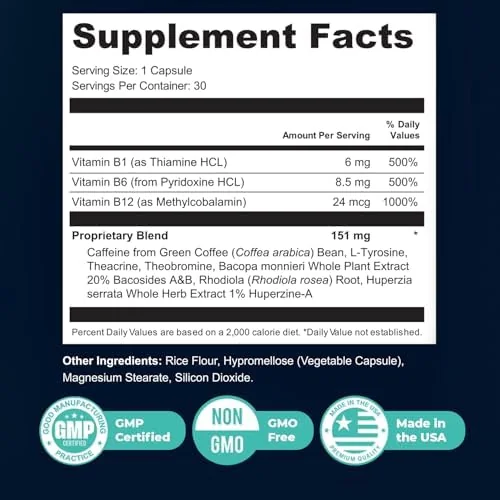
The full Memo Matrix ingredient list, line by line
A Supplement Facts panel is a legal document rather than a marketing asset, which makes it the most reliable thing on any sales page. Everything in the table below is transcribed from the Memo Matrix panel, in the order it appears.
| Line on the panel | Amount per capsule | Category |
|---|---|---|
| Vitamin B1 (as Thiamine HCl) | 6 mg (500% DV) | Vitamin, disclosed |
| Vitamin B6 (from Pyridoxine HCl) | 8.5 mg (500% DV) | Vitamin, disclosed |
| Vitamin B12 (as Methylcobalamin) | 24 mcg (1000% DV) | Vitamin, disclosed |
| Caffeine from green coffee (Coffea arabica) bean | 151 mg combined individual amounts not disclosed | Stimulant |
| L-Tyrosine | Amino acid | |
| Theacrine | Energy blend | |
| Theobromine | Energy blend | |
| Bacopa monnieri whole plant extract (20% Bacosides A&B) | Memory botanical | |
| Rhodiola rosea root | Adaptogen | |
| Huperzia serrata whole herb extract (1% Huperzine-A) | Cholinergic |
Beneath the actives the panel lists the other ingredients — rice flour, hypromellose (the vegetable capsule shell), magnesium stearate and silicon dioxide — four excipients that are not there for an effect on you. One detail is worth pausing on: US labelling convention lists blend components in descending order by weight, so caffeine printed first and Huperzia serrata last tells you the rough shape of the blend even though it gives you none of the numbers.
What each Memo Matrix ingredient is there to do
The formula is built around two different clocks: a stimulant group you notice the same afternoon, and a botanical group that only makes sense over weeks. Reading the panel with that split in mind explains most of the design.
Bacopa monnieri whole plant extract, 20% Bacosides A&B
Bacopa is the best-evidenced ingredient on this label. The active compounds are the bacosides, and a 2014 meta-analysis of randomised controlled trials in the Journal of Ethnopharmacology found a small but consistent improvement in the acquisition and retention of new information, appearing only after roughly eight to twelve weeks of daily use. The 20% standardisation is printed, which is more than many labels manage; the milligram figure behind it is not. We go deeper into the trial data in our piece on what the Bacopa monnieri and Huperzine-A research actually shows.
Huperzia serrata whole herb extract, 1% Huperzine-A
Huperzine-A is an acetylcholinesterase inhibitor: it slows the enzyme that clears acetylcholine, the neurotransmitter most tied to learning and memory. That is genuine pharmacology rather than a nutritional effect, and it is why the ingredient is dosed in micrograms elsewhere in the industry. A systematic review and meta-analysis in PLoS One (2013) found the clinical signal comes overwhelmingly from studies in cognitive decline rather than in healthy adults, so its presence here is best read as mechanistic support, not as a proven memory effect in a well person.
L-Tyrosine
L-tyrosine is the amino acid precursor the body uses to build dopamine and noradrenaline. Its evidence, summarised in a review in the Journal of Psychiatric Research (2015), is specifically about protecting cognitive performance under stress, cold, noise or sleep loss — conditions in which those neurotransmitters are being spent faster than they are replaced. It is not a compound that lifts a rested baseline, and a label claiming otherwise would be overstating it.
Rhodiola rosea root
Rhodiola is an adaptogen studied for fatigue and stress resilience rather than for memory, and a systematic review of randomised clinical trials in Phytomedicine (2011) found the trials small and methodologically mixed. Treat it as a stamina ingredient with a plausible case, not as a second memory active.
Caffeine from green coffee bean, theacrine and theobromine
These three are the same-day half of the formula. Caffeine is the most reliable cognitive ingredient in the supplement aisle for alertness, and the one whose missing figure matters most: without it you cannot count this capsule toward a daily caffeine limit. Theacrine and theobromine are caffeine-adjacent methylxanthines added for a smoother, longer profile, and the human data for both at blend-sized doses is thin. Note what is not here: no L-theanine, the amino acid usually paired with caffeine to blunt jitteriness, which has a systematic review and meta-analysis in Nutrition Reviews (2014) behind it. Our guide to the L-theanine and caffeine stack explains how that pairing is assembled.
Vitamins B1, B6 and B12
The three B vitamins are the only ingredients with printed doses, and all sit well above the daily value: 500% for B1 and B6, 1000% for B12. Water-soluble B vitamins tolerate high intakes reasonably well, with one caveat — very high long-term B6 intake has been associated with peripheral nerve symptoms, so count every source rather than stacking B-containing products. They matter most where intake or absorption is genuinely short, which is a question a blood test answers and a label cannot.
Want to see the panel in context?
The official product page publishes the same Supplement Facts panel alongside current pricing and the refund window.
Check the Official Label & PriceWhat the 151 mg proprietary blend does not tell you
A proprietary blend is a disclosure format that gives one combined weight for a group of ingredients instead of a figure for each. It is legal, it is common, and it is the single biggest limitation of this label. Seven actives share 151 mg, which is a modest total to begin with, and the split between them is unknowable from the outside.
The practical consequence is specific rather than vague. The bacopa research used around 300 mg per day of a standardised extract; the entire blend here is half that figure, shared seven ways. Nothing on the panel establishes that the bacopa portion is anywhere near a studied dose, and nothing establishes that it is not. That is the honest position, and it is the reason we would not describe this formula as a bacopa supplement.
The same uncertainty runs the other way for caffeine. It is listed first, so it is the largest single component, but "largest of seven inside 151 mg" still leaves a wide range, and anyone caffeine-sensitive or already drinking coffee is dosing blind. Taking the capsule in the morning is the sensible hedge.
Which Memo Matrix ingredients have real human evidence
Grading this list honestly means separating three things: evidence for the compound, evidence at the dose used here, and evidence for the finished product. Only the first exists for any ingredient on this panel.
| Ingredient | Strength of human evidence | What it is evidence for |
|---|---|---|
| Caffeine | Strong | Same-day alertness and attention |
| Bacopa monnieri | Moderate | Memory acquisition over 8–12 weeks |
| L-Tyrosine | Moderate, narrow | Performance under stress or sleep loss |
| Huperzine-A | Moderate, wrong population | Mainly studied in cognitive decline |
| Vitamins B1, B6, B12 | Strong for deficiency correction | Correcting a measured shortfall |
| Rhodiola rosea | Limited and mixed | Fatigue and stress resilience |
| Theacrine, theobromine | Limited at these doses | Supporting the stimulant profile |
A long ingredient list is easy to produce; one you can check against the literature is not, which is why disclosed dosing is the first filter worth applying. Our nootropic supplement buyer's guide sets out the four questions worth asking before any purchase, and our guide to choosing a memory supplement applies the same test across the category.
What this ingredient list cannot tell you: the honest limits
Three limits are worth stating plainly, because a page that only lists benefits is not much use to a buyer.
It cannot tell you what the product does in a person. Memo Matrix has not been the subject of its own clinical trial. Every study cited here tested a single compound at a known dose in a specific population, and assembling evidenced ingredients does not produce an evidenced product. That gap is why so many buyers conclude that memory pills do not work after trying a formula that never matched a studied dose.
It cannot support a disease claim. Nothing here is intended to diagnose, treat, cure or prevent any condition, and memory loss or confusion are medical situations that need assessment rather than a capsule.
It cannot substitute for the basics. Sleep, fitness, blood pressure, hearing and social engagement all carry more evidence for cognitive ageing than any supplement panel. Our full assessment of whether Memo Matrix works puts these ingredients in the context of price, timeline and refund terms.
Medical note: this article is general information, not medical advice. Ingredient details are transcribed from the published Memo Matrix label and may change without notice, so check the physical bottle. Speak to a healthcare professional before starting any supplement, especially if you are pregnant, nursing, caffeine-sensitive, under 18 or taking medication — Huperzine-A is pharmacologically active and can interact with several drugs.
Frequently asked questions
What are the ingredients in Memo Matrix?
The Supplement Facts panel lists Vitamin B1 as thiamine HCl at 6 mg, Vitamin B6 from pyridoxine HCl at 8.5 mg and Vitamin B12 as methylcobalamin at 24 mcg, plus a 151 mg proprietary blend containing caffeine from green coffee (Coffea arabica) bean, L-tyrosine, theacrine, theobromine, Bacopa monnieri whole plant extract standardised to 20% Bacosides A&B, Rhodiola rosea root and Huperzia serrata whole herb extract standardised to 1% Huperzine-A. The other ingredients are rice flour, hypromellose for the vegetable capsule, magnesium stearate and silicon dioxide.
How much of each ingredient is in the proprietary blend?
The label does not say. Seven actives share one 151 mg total, and the individual milligrams are not broken out. You can see the standardisations, 20% Bacosides A&B for the Bacopa and 1% Huperzine-A for the Huperzia serrata, but not the weight each ingredient contributes. That means no single ingredient in the blend can be compared directly against the dose used in a published trial.
How much caffeine is in Memo Matrix?
The amount is not printed. Caffeine from green coffee bean is named first inside the 151 mg blend, and US labelling convention lists blend components in descending order by weight, so caffeine is the largest single component of the blend. Because the figure is undisclosed, treat the capsule as an unknown addition to your daily caffeine and take it in the morning rather than late in the day.
Is Bacopa monnieri the main ingredient in Memo Matrix?
It is the best-evidenced ingredient on the label, but it is not the largest. Bacopa monnieri whole plant extract is listed fifth of the seven blend components, which places it below caffeine, L-tyrosine, theacrine and theobromine by weight. That ordering matters, because the memory research on Bacopa used around 300 mg per day of a standardised extract.
Does Memo Matrix contain any allergens or animal products?
The panel lists rice flour, hypromellose, magnesium stearate and silicon dioxide as the other ingredients, and hypromellose is a plant-derived capsule shell rather than gelatin. The label makes no allergen declaration beyond that list, so anyone with a specific allergy should read the physical bottle and contact the seller before buying.
Scientific references
- Kongkeaw C. et al. — Meta-analysis of randomized controlled trials on cognitive effects of Bacopa monnieri extract, Journal of Ethnopharmacology (2014)
- Yang G. et al. — Huperzine A for Alzheimer's disease: a systematic review and meta-analysis of randomized clinical trials, PLoS One (2013)
- Jongkees B.J. et al. — Effect of tyrosine supplementation on clinical and healthy populations under stress or cognitive demands: a review, Journal of Psychiatric Research (2015)
- Hung S.K. et al. — The effectiveness and efficacy of Rhodiola rosea L.: a systematic review of randomized clinical trials, Phytomedicine (2011)
- Camfield D.A. et al. — Acute effects of tea constituents L-theanine, caffeine and epigallocatechin gallate on cognitive function and mood: a systematic review and meta-analysis, Nutrition Reviews (2014)
- NIH Office of Dietary Supplements — Vitamin B6 fact sheet for health professionals
- NIH Office of Dietary Supplements — Vitamin B12 fact sheet for health professionals
- Federal Trade Commission — Health products compliance guidance
See the full label and current pricing
Ten named ingredients, three disclosed vitamin doses and a 60-day refund window — all on the official store page.
Check the Official Price